Why Non-Commissioned Specialists Provide the Most Honest Grease Trap Cleaning
An honest grease trap cleaning is defined by a service that prioritizes your kitchen’s operational health over a technician's sales quota. When a provider pays their team based on commissions, you often end up with "required" add-ons you don't actually need; however, a non-commissioned specialist focuses strictly on the 1/4 Rule and regulatory compliance.
For restaurant owners, this is the difference between a routine maintenance cost and an inflated invoice filled with high-pressure upswells. Neglecting this transparency can lead to more than just high bills—it often results in overlooked system flaws that cause catastrophic backups during your busiest shifts.
In this guide, you will learn how the non-commissioned model protects your bottom line, how to identify genuine maintenance needs, and why local expertise is your best defense against expensive plumbing emergencies.
Here is how choosing the right partner ensures your facility stays compliant without the sales pitch.
Defining Professional Grease Trap Maintenance and Why It Matters
At its core, grease trap maintenance is the systematic removal of fats, oils, and grease (FOG) from a kitchen's drainage system to ensure the local sewer lines remain clear. This process involves more than just a surface-level skim; it requires the complete evacuation of accumulated sludge and floating grease layers, followed by a thorough scraping of the interceptor walls and a check of the internal baffles.
When performed correctly, this service prevents the solidifying grease from escaping into the public wastewater infrastructure, where it can cause massive blockages and environmental damage.
For a restaurant owner or facility manager, the quality of your grease trap cleaning is directly linked to your business’s continuity. A poorly maintained system is a ticking clock; eventually, the grease will overwhelm the trap, leading to slow drains, foul smells in the dining area, and the highly expensive risk of a floor-drain backup during peak hours. In a city with strict health codes, failing to maintain your system isn't just a plumbing issue—it is a regulatory liability that can result in immediate closure.
By prioritizing professional, non-commissioned service, you secure several key advantages:
- Operational Reliability: Ensuring your kitchen can handle high-volume demand without drainage failure.
- Regulatory Compliance: Meeting the "1/4 Rule" standards required to pass city and state health inspections.
- Cost Savings: Avoiding the "emergency premium" prices associated with rapid response repairs and avoidable backups.
A common misconception is that all cleaning services are equal as long as the tank is emptied. However, the true value lies in the diagnostic expertise of the specialist, which is often compromised when technicians are incentivized to sell parts rather than solve problems.
The Non-Commissioned Advantage: Why Transparency is Key
Choosing a service provider that employs non-commissioned technicians is the most effective way to ensure you receive an honest grease trap cleaning. In an industry where many companies incentivize their employees to "find" problems, our model focuses entirely on the technical health of your system and your standing with local health inspectors.
When a specialist isn't chasing a sales bonus, their only goal is to perform a high-quality grease trap pumping that keeps you compliant and your kitchen running smoothly.
How an Honest Grease Trap Cleaning is Performed
To understand why the "anti-sales" approach saves you money, it helps to know exactly what is grease trap cleaning when done to professional standards. A truly thorough service isn't just about removing the top layer of oil; it is a multi-step engineering process designed to reset your system to its baseline efficiency.
- System Assessment: The technician first measures the thickness of the grease and solids to verify if you are meeting the "1/4 Rule."
- Complete Evacuation: Using specialized grease trap cleaning equipment, the specialist suctions out every gallon of liquid, sludge, and floating grease.
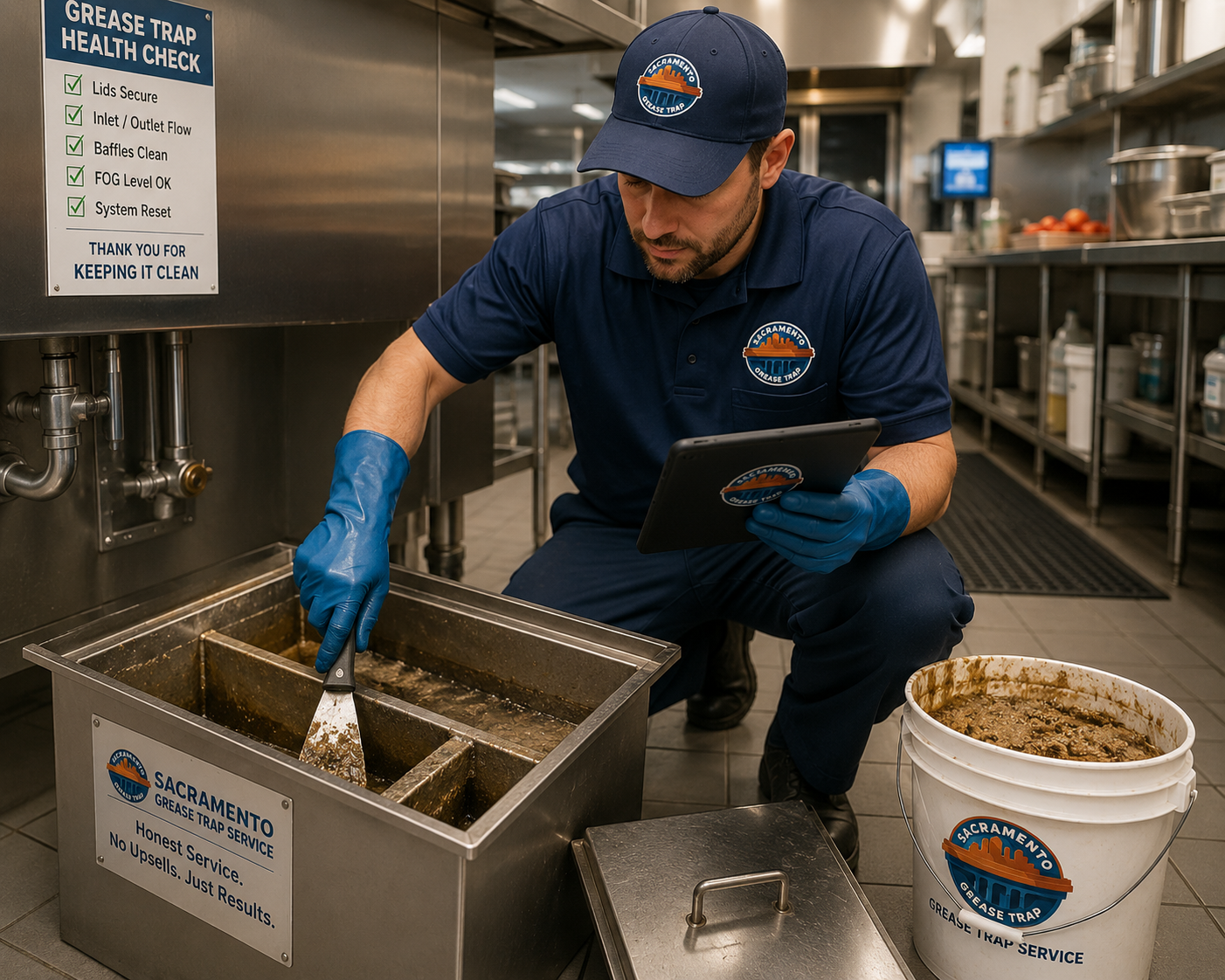
- The Clean-Out Service: This involves scraping the sidewalls and bottom of the unit to remove hardened "grease scale" that can cause odors and corrosion.
- Baffle and Seal Inspection: A non-commissioned pro will check the intake and outlet baffles. If they are worn, they’ll tell you—not to sell a part, but to prevent grease from escaping into the city lines.
- Flow Testing: After the grease interceptor cleaning, the technician will run water through the kitchen sinks to ensure the system is venting correctly and draining at full capacity.
Identifying Genuine Maintenance vs. Upselling
The difference between a necessary repair and an upsell often comes down to the technician’s incentive. For example, a commissioned plumber might suggest expensive chemical additives or high-frequency cleaning schedules that exceed what your actual FOG output requires.
An honest specialist, however, will guide you through the F.O.G. best practices that actually reduce your need for service. They might show you how to use better grease trap cleaning tools like sink strainers or suggest staff training to prevent food solids from entering the trap in the first place. This problem-solving approach prioritizes your long-term success over a one-time high invoice.
Ensuring Proper Grease Trap Waste Disposal
Finally, an honest provider takes full responsibility for the grease trap waste cleaning cycle, including legal disposal. In Sacramento, you are legally responsible for your waste from "cradle to grave." A transparent service provides you with a completed manifest, proving that your grease trap waste disposal followed all environmental regulations. This documentation is your best defense during a surprise city audit.
By removing the pressure of commissions, the focus shifts back to what matters: keeping your kitchen operational, your costs predictable, and your business in total compliance with the law.
Honest Work in Action: Real-World Scenarios
Transitioning from the theory of "anti-sales" to a functioning kitchen environment shows how transparency directly impacts your daily operations. These real-world examples illustrate how an honest approach to maintenance prevents the common pitfalls of the food service industry.
- The Over-Serviced Family Diner: A local breakfast spot was paying for monthly pumping based on a competitor's recommendation. After switching to our non-commissioned team, we performed a technical assessment and determined their actual FOG output only required service every 90 days. By aligning their commercial grease trap maintenance with their actual needs, the owner saved over $2,000 annually without risking a single backup.
- The "Failed" Health Inspection: A Midtown restaurant was cited for a missing baffle that a previous commissioned technician had ignored. Our specialist performed a comprehensive grease trap clean-out service, replaced the missing hardware, and provided the documentation needed to clear the citation.
The result was a fully compliant system and an owner who finally felt like a partner rather than a sales target.
- The Hospital Cafeteria: A large-scale facility needed a reliable partner to manage massive underground interceptors. By utilizing a proactive schedule, they avoided the emergency fees associated with large-scale blockages while maintaining 100% compliance with municipal waste standards.
As these scenarios demonstrate, prioritizing honesty over high-pressure sales isn't just a philosophy—it’s a practical strategy for long-term business stability.
Maximizing the Efficiency of Your Grease Trap Maintenance
Moving beyond the basic pumping schedule allows you to take full control of your kitchen’s plumbing health and long-term costs. Implementing these professional strategies ensures that your commercial grease trap maintenance is as effective as possible, protecting both your facility and your bottom line.
- Implement "Dry-Wiping" Protocols: Before any plates or cookware reach the three-compartment sink, ensure staff use rubber scrapers to remove solid food and congealed fats into the trash.
This simple habit drastically reduces the volume of grease trap waste cleaning required, preventing the trap from reaching the 25% capacity limit prematurely and extending the time between professional services.
- Audit Your Service Manifests Regularly: Always verify that your technician provides a detailed service report that includes the volume removed and the disposal site.
Proper documentation is a core part of grease trap maintenance in Sacramento; without it, you could be held liable for illegal dumping. Keeping these records organized ensures you are always prepared for a surprise health department audit.
- Invest in Quality Sink Strainers: The most effective grease trap cleaning tools are actually the ones that prevent waste from entering the pipes in the first place. High-quality, fine-mesh strainers in every sink—including floor sinks—catch small food particles that would otherwise settle as sludge, making your scheduled cleaning visits faster and more effective.
- Monitor Water Temperatures: Avoid using "boiling" water to flush grease down the drain. While it might appear to clear the sink, it actually melts the grease just enough to bypass the trap, only for it to solidify further down the line in the city main. Keeping water at standard commercial temperatures allows your grease interceptor to cool the water and trap FOG effectively.
By applying these proactive habits, you shift from reactive emergency repairs to a streamlined, cost-effective maintenance model that ensures your kitchen remains a local leader in sanitation.
Secure the Best Prices with Honest Grease Trap Cleaning
By choosing a non-commissioned specialist, you ensure that your grease trap maintenance is driven by technical necessity rather than a sales quota. You now understand that an honest grease trap cleaning involves a full system reset—evacuating the tank, inspecting the baffles, and providing the legal documentation required by Sacramento law.
This transparent approach not only protects you from unnecessary upselling but also guarantees that your kitchen remains 100% compliant with the "1/4 Rule."
Prioritizing honest, expert service today is the best way to prevent the high-stakes plumbing emergencies and health department fines that can derail your business. Taking control of your FOG management gives you the peace of mind to focus on your customers while we handle the dirty work. If you are tired of high-pressure sales and want to partner with a team that values your long-term success, reach out to us for a professional grease trap cleaning.
Common Questions About Honest Grease Trap Cleaning
How can I tell if I am receiving an honest grease trap cleaning?
An honest grease trap cleaning is verifiable through total transparency. A reputable technician will show you the empty tank to prove that all settled solids and floating grease layers were removed, rather than just "skimming" the top.
They should also provide a manifest for grease trap waste disposal and a clear report on the condition of your baffles. If a technician pressures you into immediate, expensive repairs without showing you the wear and tear, it may be a commission-driven upsell.
What is grease trap cleaning versus a simple pump-out?
While many use the terms interchangeably, a "pump-out" often refers only to the removal of liquid waste. In contrast, true grease trap maintenance involves a comprehensive cleaning of the unit.
This includes scraping the side walls to remove hardened FOG and clearing the intake and outlet pipes. Using specialized grease trap cleaning equipment to reset the unit to its "empty" state is the only way to ensure you stay within the city's 25% capacity limit for longer periods.
Can staff perform grease trap cleaning for restaurants?
Technically, staff can clean small, under-sink traps, but it is rarely recommended for commercial compliance. Most municipal regulations require professional documentation to prove that grease trap waste cleaning was handled by a licensed hauler.
Without a professional manifest, your business could be liable for heavy fines if the waste is traced to improper disposal. Furthermore, professional specialists have the F.O.G. best practices and tools to handle the hazardous odors and hygiene risks safely.
Why are non-commissioned technicians better for my budget?
Non-commissioned specialists are paid for their technical expertise and work quality, not for the size of the final invoice. This model eliminates the conflict of interest found in many plumbing companies.
When your specialist isn't incentivized to sell you parts or extra visits, they provide a more accurate assessment of your grease interceptor cleaning needs. This results in "Honest Work" that focuses on preventing backups and ensuring regulatory compliance rather than padding the bill.

Let Us Simplify Your Grease Trap Maintenance.
Proper grease trap maintenance will reduce costly repairs in the future.
.avif)