Decoding the 1/4 Rule: When You Need Professional Grease Trap Services
The 1/4 Rule dictates that your grease trap must be cleaned before the accumulation of fats, oils, and grease (F.O.G.) reaches 25% of its total capacity. If you exceed this limit, your system loses its ability to separate waste effectively, leading to foul odors, slow drains, and high-stakes plumbing backups that can shut down your kitchen. For business owners in the capital region, staying ahead of this threshold with regular grease trap services is the difference between a smooth-running shift and a costly visit from a health inspector.
While it might be tempting to delay maintenance, ignoring F.O.G. compliance in Sacramento often results in city fines and emergency repairs that far exceed the price of a scheduled pump. By the end of this guide, you will understand exactly how to measure your trap's levels, how to maintain professional grease interceptor maintenance schedules, and how to protect your bottom line from preventable disasters.
Here is what every facility manager and restaurant owner needs to know about the science of the 1/4 Rule.
Understanding the 1/4 Rule for Effective Grease Trap Services
The 1/4 Rule is a universal industry standard used to determine the exact moment a grease interceptor requires servicing. It states that once a grease trap is filled to 25% of its total capacity with floating grease and settled solids, it is no longer functional. At this saturation point, the device loses the hydraulic retention time necessary to separate grease from water, allowing fats and oils to escape into the city sewer lines. Essentially, the rule acts as a "tripwire" for grease trap services, signaling that the system has reached its maximum efficiency and must be emptied.
For Sacramento business owners, this rule is not just a technicality; it is a critical safeguard against operational failure. When you neglect grease trap cleaning, the excess F.O.G. bypasses the tank and hardens in your internal plumbing or the municipal main. This leads to:
- Costly Backups: Raw sewage and greasy water backing up into your floor drains during peak hours.
- Regulatory Fines: Citations from local inspectors for violating F.O.G. compliance in Sacramento.
- Property Damage: Long-term corrosion of pipes and expensive grease trap pumping requirements to clear major blockages.
Adhering to this rule ensures your kitchen remains sanitary and your business stays in the good graces of environmental regulators. A common misconception is that a grease trap only needs cleaning when it starts to smell or drain slowly. In reality, once those symptoms appear, you have likely already exceeded the 1/4 threshold and are operating at a high risk for a plumbing emergency. Professional grease interceptor pumping is about prevention, not just reaction.
The Mechanics of Compliance: How to Measure and Manage the 1/4 Rule
Understanding the 1/4 Rule is the first step toward maintaining a safe and efficient kitchen. However, knowing the rule and knowing how to apply it are two different challenges. Because every commercial kitchen has a different volume of output, there is no "one-size-fits-all" schedule for grease trap services. A high-volume steakhouse might hit the 25% threshold in two weeks, while a small boutique cafe might take two months. Managing this requires a proactive approach to F.O.G. best practices to ensure you never cross the line into non-compliance.
Step 1: Identify Your Trap’s Total Depth
To calculate the 25% threshold, you first need to know the static liquid depth of your interceptor. This is the distance from the bottom of the tank to the top of the water level (the bottom of the outlet pipe). For example, if your tank is 24 inches deep from the floor of the unit to the water line, your "action level" is 6 inches. Once the combined thickness of the floating grease cap and the settled solids at the bottom reaches 6 inches, you must schedule professional grease interceptor maintenance.
Step 2: Use the "Dipstick" Method
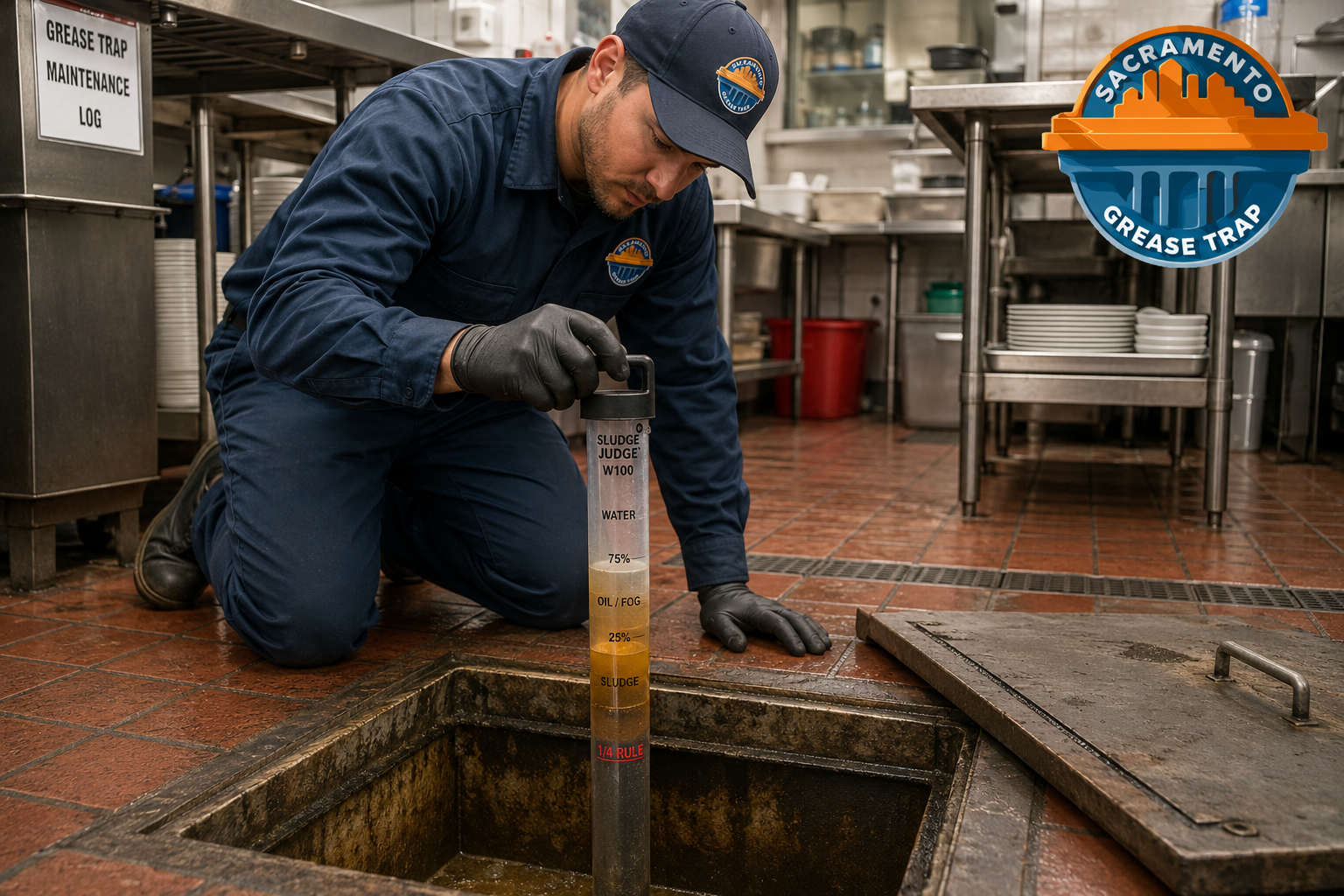
The most accurate way to check your levels is with a clear sludge judge or a simple dipstick.
- Insert the probe: Slowly lower the device through the center of the trap until it hits the bottom.
- Observe the layers: When you pull the probe out, you will see three distinct layers: the top layer of grease (F.O.G.), the middle layer of relatively clear water, and the bottom layer of food solids and sludge.
- Measure the waste: Add the thickness of the top grease layer to the thickness of the bottom solids layer. If this sum is equal to or greater than 25% of the total depth you measured in Step 1, your system is failing to protect the Sacramento grease management infrastructure.
Step 3: Document and Adjust Your Schedule
The 1/4 Rule isn't just about cleaning; it’s about data. We recommend that kitchen managers log their levels weekly for the first month. By tracking how quickly the grease accumulates, you can establish a precise pumping frequency. If you find that you hit the 25% mark every six weeks, scheduling your grease trap services every five weeks provides a safety margin that prevents emergencies. This data is also invaluable when health inspectors ask for proof of your maintenance history.
Common Signs You’ve Exceeded the 1/4 Limit
While the dipstick method is the only "official" way to check, your kitchen will often give you physical warnings when the trap is over-saturated:
- Gurgling Drains: As the trap fills, air cannot move freely through the lines, causing a gurgling sound in your sinks.
- Slow Drainage: If multiple sinks are draining slowly, the blockage is likely at the interceptor level rather than a single pipe.
- Persistent Odors: When the grease cap becomes too thick, it begins to rot and release hydrogen sulfide gas, which can permeate the dining area.
Why Professional Monitoring Matters
Many business owners attempt to "self-clean" small indoor traps to save on restaurant grease trap cleaning costs. While this is legal in some jurisdictions, it is rarely done effectively. Without high-volume pumping equipment, it is nearly impossible to remove the heavy solids settled at the bottom. These solids are half of the 1/4 Rule equation; if they aren't removed, your trap will hit the 25% limit again in a fraction of the time.
By partnering with a technician who understands local grease management solutions, you ensure that the entire unit is scraped and cleaned, resetting your "clock" completely. This proactive management keeps your kitchen operational and ensures that you are never caught off guard by a surprise inspection or a sudden floor drain overflow during a Friday night rush.
The 1/4 Rule in Action: Real-World Scenarios for Sacramento Kitchens
Applying the 1/4 Rule effectively depends on the specific demands of your facility. Here is how different businesses utilize professional grease trap services to maintain their systems and remain compliant.
- The High-Volume Local Diner: A popular breakfast spot in Roseville noticed their drains slowing down every Sunday morning. By implementing a monthly schedule for grease trap pumping, they discovered they were reaching the 25% threshold every 28 days due to high bacon grease output. Since moving to a proactive schedule, they have eliminated weekend plumbing emergencies and reduced their overall restaurant grease trap cleaning cost by avoiding emergency call-out fees.
- The Suburban Elementary School: A school district facility manager needed to ensure F.O.G. compliance in Sacramento for multiple cafeterias. By scheduling professional grease interceptor maintenance during winter and summer breaks, the district ensured that stagnant grease didn’t harden and cause a backup during the school year. This preventative approach kept the school in full compliance with municipal health codes without interrupting student meal services.
- The Boutique Downtown Cafe: A small coffee shop with limited kitchen space used a small under-sink trap. Because their footprint was tiny, even a small amount of waste triggered the 1/4 Rule quickly. By partnering with a local specialist for regular grease trap services, they kept their guest area odor-free and avoided the catastrophic "rotten egg" smell that can drive away customers.
These examples demonstrate that regardless of your kitchen's size, adhering to the 1/4 Rule is a practical strategy that yields measurable results in safety and efficiency.
Proactive Strategies for Maintaining F.O.G. Compliance
Moving from basic knowledge to master-level grease management requires more than just watching the clock; it requires the right habits. These experience-based tips represent the difference between a kitchen that barely passes inspection and one that sets the standard for grease trap services in our community.
- Implement a "Dry Scraping" Policy: Before any plate or pan hits the three-compartment sink, ensure staff scrape food solids and oils into the trash. This simple habit dramatically slows down the rate at which you hit the 25% threshold, directly reducing your annual restaurant grease trap cleaning cost.
- Monitor Water Temperatures: While hot water helps move grease through your internal pipes, water that is too hot can temporarily melt the grease cap in your trap, allowing it to escape into the city sewer. Keeping your water at the manufacturer-recommended temperature ensures your grease interceptor pumping remains effective by keeping the F.O.G. trapped where it belongs.
- Avoid Enzyme or Chemical "Additives": Many vendors sell "grease-eating" bacteria or enzymes that claim to eliminate the need for cleaning. In reality, these often just liquefy the grease so it passes through the trap and solidifies in the city main—a major violation of F.O.G. compliance in Sacramento. Stick to mechanical cleaning to ensure long-term system health.
- Schedule Off-Peak Maintenance: To avoid disrupting your service or your customers' experience, schedule your professional grease interceptor maintenance during early morning or late evening hours. A reputable service provider will work around your "rush" to ensure your kitchen stays operational without the lingering odors of a mid-service pump.
Applying these best practices ensures that your system remains efficient between professional visits, protecting your plumbing and your reputation.
Secure Your Kitchen’s Future with Expert Grease Trap Services
By decoding the 1/4 Rule, you now have the blueprint for maintaining a compliant, odor-free, and efficient commercial kitchen. You understand that scheduling grease trap services before waste reaches 25% of your tank's capacity is the only way to prevent costly backups and stay ahead of F.O.G. compliance in Sacramento. This proactive approach transforms grease management from a stressful emergency into a predictable, manageable part of your successful business operations.
Taking action today protects your infrastructure from long-term damage and ensures your team can focus on what they do best: serving your customers. Don't wait for a slow drain or a health department citation to remind you that your system is full. Whether you need a one-time pump or a customized preventative kitchen plumbing plan, our team of non-commissioned specialists is ready to provide the honest, expert support your business deserves.
Ready to clear the way for a more efficient kitchen? Contact Sacramento Grease Trap Service today for a free consultation and the best prices on professional grease trap services in the region.
Frequently Asked Questions About Grease Trap Services
How much does professional grease trap cleaning cost?
The price typically depends on the size of your interceptor and the frequency of the service. While small under-sink units are more affordable to pump, larger outdoor interceptors require specialized vacuum trucks. By sticking to the 1/4 Rule, you can actually lower your restaurant grease trap cleaning cost over time because the waste remains liquid and easier to remove, preventing the need for additional labor or hydro-jetting to clear hardened blockages.
Can I clean my own grease trap to save money?
While some small businesses attempt DIY cleaning, it is rarely recommended for full F.O.G. compliance in Sacramento. Manual cleaning often misses the heavy solids settled at the bottom, which quickly triggers the 1/4 Rule again. Furthermore, professional grease trap services provide the manifest documentation required by health inspectors to prove legal disposal, something you cannot obtain when cleaning the unit yourself.
What happens if I ignore the 1/4 Rule?
Ignoring this threshold leads to "bypass," where grease flows directly into the city sewer lines. This can result in massive municipal fines and emergency plumbing backups that shut down your kitchen. Routine grease trap maintenance is the only way to ensure your interceptor continues to protect your pipes and the local environment from fats, oils, and grease.
How often should I schedule grease trap services?
Most busy restaurants require pumping every 30 to 90 days to stay under the 25% waste limit. However, the best way to determine your specific needs is through a professional inspection. A technician can measure your accumulation rate and help you establish local grease management solutions that fit your kitchen's specific volume, ensuring you never face an unexpected overflow during peak hours.

Let Us Simplify Your Grease Trap Maintenance.
Proper grease trap maintenance will reduce costly repairs in the future.
.avif)