Set It and Forget It: Automating Compliance with Precise Grease Trap Measurements
To ensure your kitchen stays compliant and avoids catastrophic backups, you must base your service schedule on accurate grease trap measurements that reflect your actual kitchen output. Relying on guesswork rather than a data-driven grease trap sizing guide often leads to overflows or failing a surprise municipal inspection.
For Sacramento restaurant owners, an undersized or neglected system isn't just a nuisance; it is a financial liability that can result in immediate health department closures and expensive emergency plumbing repairs.
In this guide, you will learn the technical standards for grease trap sizing and how to calculate the exact capacity your facility requires. You will gain the clarity needed to automate your maintenance schedule, ensuring your business remains operational and protected from regulatory fines.
Let's dive into the core metrics that keep your drainage system functional.
The Science of Flow: Why Precise Grease Trap Measurements Matter
In the world of commercial kitchen management, grease trap measurements refer to the specific calculations used to determine the volume and flow rate capacity of your interceptor.
This process involves measuring the physical dimensions of the tank and evaluating the maximum drainage output from your connected fixtures, such as three-compartment sinks and dishwashers. By establishing these metrics, you can accurately track the "1/4 Rule," which dictates that a trap must be pumped once it is 25% full of accumulated fats and solids.
Understanding these technical figures is essential because an incorrectly sized system is the leading cause of environmental non-compliance. For a Sacramento business owner, failing to utilize a proper grease trap sizing guide can lead to grease bypassing the system entirely and entering the city sewer line. This doesn't just result in heavy municipal fines; it creates a genuine risk of sewage backing up into your food preparation areas, endangering both your staff and your operating permit.
Accurate measurements provide several critical advantages:
- Automated Compliance: You can predict exactly when your tank will reach the 25% threshold, allowing for "set it and forget it" scheduled maintenance.
- Cost Efficiency: You avoid paying for premature pumping while ensuring you never wait long enough for an emergency overflow to occur.
- System Longevity: Properly sized traps prevent the corrosive "grease scale" that eats away at pipes when flow rates are too high for the tank's capacity.
A common mistake is assuming that a larger tank is always better. In reality, grease trap sizing must be balanced with your kitchen's specific flow rate; otherwise, water stays in the tank too long, leading to hydrogen sulfide gas and severe odor issues.
How to Calculate and Apply Accurate Grease Trap Measurements
Accurate grease trap measurements are the backbone of a functional kitchen, ensuring that your waste management system is neither underperforming nor over-servicing.
By mastering the technical side of grease trap sizing, you can transition from reactive emergency repairs to a streamlined, automated compliance schedule. This section provides a step-by-step breakdown of how to size your system and the specific variables required for an accurate calculation.
Step 1: Calculate the Volume of Your Fixtures
The first step in grease trap sizing is determining the total volume of all sinks and drains that will discharge into the unit. This is the foundation of the "total flow" calculation.
- Measure the length, width, and depth (in inches) of each sink compartment.
- Multiply these three figures to get the total cubic inches.
- Divide the result by 231 (the number of cubic inches in a gallon) to find the capacity in gallons.
Tip: Most industry standards suggest calculating sink capacity at 75% of the total volume to account for water displacement from dishes and the fact that sinks are rarely filled to the absolute brim.
Step 2: Determine the Flow Rate (GPM)
Once you know the volume, you must determine the Gallons Per Minute (GPM) flow rate. This dictates how quickly water will enter the interceptor. For most commercial kitchen grease trap guidelines, a standard "one-minute drain time" is used. If your sink holds 20 gallons and you want it to drain in 60 seconds, your flow rate is 20 GPM.
Step 3: Consult a Grease Trap Size Chart
After calculating your GPM, you can reference a grease trap size chart to select the appropriate unit. These charts correlate your flow rate with the "grease retention capacity" (measured in pounds). For example, a 20 GPM trap typically has a 40-pound grease capacity. Choosing a unit that matches your peak flow ensures that the water remains in the tank long enough for the fats to cool and separate properly.
Step 4: Account for High-Volume Equipment
If your kitchen utilizes high-temp dishwashers or floor drains that handle large wash-downs, your grease interceptor sizing must be adjusted upward.
- Dishwashers: These discharge high-velocity, hot water that can "scour" grease through a trap if it is too small. Use a specialized grease trap sizing calculator or add a 25% safety margin to your GPM if a dishwasher is on the line.
- Floor Drains: In Sacramento, floor drains are often calculated by their diameter, with a standard 2-inch drain adding roughly 22 GPM to your total required capacity.
Step 5: Implement the 1/4 Rule for Maintenance
With your measurements established, you can now automate your service. By knowing the total capacity of your trap, our technicians can measure the "grease blanket" during a routine visit and tell you exactly how many weeks it takes for your kitchen to reach the 25% limit. This data-driven approach is the only way to satisfy city and state grease trap regulations without overpaying for unnecessary pumping.
By following these precise steps, you move away from the "guess and check" method that often leads to costly plumbing failures. Understanding the math behind your drainage system allows you to make informed decisions about your infrastructure, whether you are managing an existing cafe or planning a new industrial kitchen.
Practical Application: Precision Grease Trap Measurements in Action
Applying mathematical precision to your drainage system transforms maintenance from a guessing game into a predictable business expense. These real-world scenarios illustrate how local Sacramento businesses use grease trap measurements to maintain flawless operations.
- High-Volume Mexican Cantina: A busy restaurant in Downtown Sacramento was experiencing mysterious backups despite monthly pumping. By performing a new sizing a grease trap calculation, we discovered that recent menu changes and increased dishwashing volume had rendered their existing unit undersized.
After upgrading to a unit with the correct GPM rating based on their actual flow, they eliminated all backup issues and reduced their emergency plumbing costs by 100%.
- Regional School District: A facility manager was struggling to coordinate service across twelve different campuses with varying kitchen sizes. We utilized a grease trap sizing calculator for each site to establish custom service intervals ranging from 60 to 90 days.
This data-driven approach ensured 100% compliance with municipal health codes while optimizing the district's maintenance budget.
- Boutique Donut Shop: A small bakery used precise grease trap measurements to prove to a skeptical landlord that their low-flow operation did not require a massive, expensive outdoor interceptor, allowing them to install a compliant, cost-effective under-sink model instead.
These examples demonstrate that when you lead with data, you gain control over your kitchen's infrastructure. Whether you are scaling up or staying lean, accurate sizing ensures your business stays protected.
Pro Tips for Managing Your Grease Trap Measurements
Refining your approach with these expert insights is what separates a standard kitchen from a high-efficiency, compliant operation. By mastering these nuances, you ensure your grease trap measurements serve as a proactive tool for business stability rather than just a technical requirement.
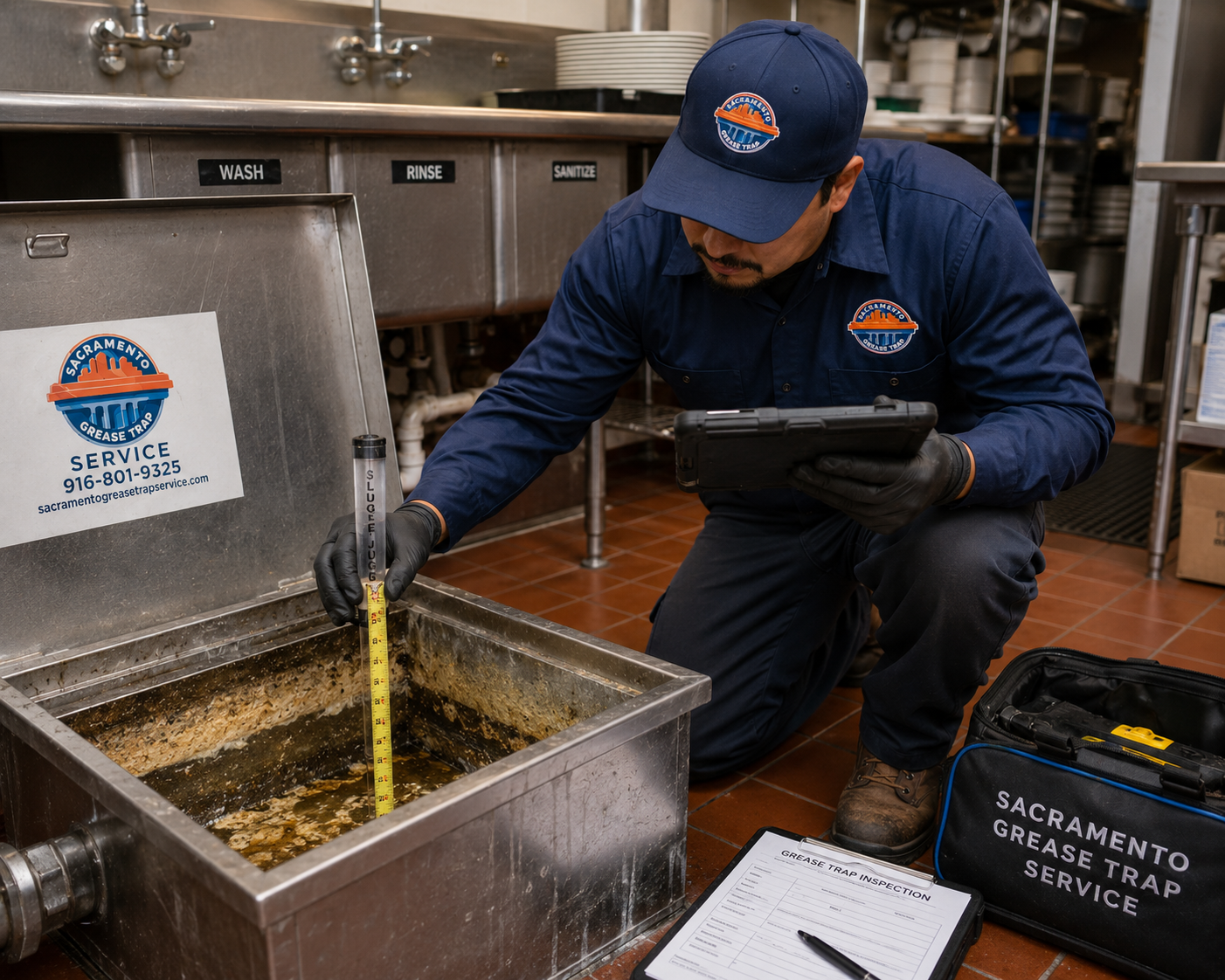
- Verify Your "Grease Blanket" Thickness: Don't just rely on the calendar; use a "Sludge Judge" or a similar measuring device to check the actual accumulation levels.
Professional grease trap measurements should confirm that the top layer of grease and the bottom layer of solids do not exceed 25% of the total liquid depth. This verified data allows you to adjust your service frequency based on seasonal menu changes or fluctuations in customer volume.
- Audit Your Flow Control Valves: Even with perfect grease trap sizing, your system can fail if the flow control valve is missing or tampered with. This small orifice regulates the speed of incoming water to ensure it matches the GPM rating of your tank.
If water enters too quickly, it creates turbulence that prevents grease from separating, leading to F.O.G. bypass and potential city fines.
- Account for Extreme Water Temperatures: If your facility uses high-heat sanitizing cycles, standard grease interceptor sizing may not be enough. Extremely hot water can keep grease emulsified, allowing it to slip through the trap before it has a chance to cool and float.
In these cases, installing a larger tank or a cooling pit ensures the laws of physics have enough time to work in your favor.
Implementing these professional standards transforms your waste management into a predictable, automated process that safeguards your kitchen's infrastructure and your bottom line.
Precision for Peace of Mind: Automating Your Compliance
By establishing accurate grease trap measurements, you have moved from guessing your maintenance needs to mastering your kitchen's regulatory requirements. You now understand how to use a grease trap sizing calculator to determine flow rates and how to apply the 1/4 Rule to prevent expensive backups before they occur.
This data-driven approach is the most effective way to ensure 24/7 kitchen efficiency while protecting your business from the "fly-by-night" service providers who rely on upselling rather than technical accuracy.
Taking control of your grease trap measurements today eliminates the stress of surprise health inspections and the threat of operational downtime. When your system is sized correctly and serviced on a predictable schedule, you can focus on your customers with the confidence that your plumbing infrastructure is secure.
To automate your kitchen’s health and lock in the best rates for honest, professional work, contact us today for a comprehensive consultation on your facility's specific grease trap requirements.
Frequently Asked Questions About Grease Trap Measurements
How do I know if I have the correct grease trap sizing?
You can determine if your system is appropriately sized by comparing your kitchen's peak flow rate (GPM) against the manufacturer’s specifications. If your unit is frequently overflowing or causing slow drains before reaching the 25% capacity limit, it is likely undersized for your current output. Utilizing a grease trap size chart can help you verify if your hardware matches the number of fixtures in your facility.
Can I perform grease trap measurements myself?
Yes, you can calculate the basic volume of your interceptor by measuring its length, width, and depth. However, professional grease trap measurements are recommended to accurately assess the "grease blanket" thickness and flow control functionality. Our certified technicians use specialized tools to provide precise data, ensuring you remain in full compliance with Sacramento’s strict environmental regulations without the risk of human error.
What happens if my grease trap measurements are inaccurate?
Inaccurate grease trap measurements often lead to "short-circuiting," where grease escapes into the city sewer because the water is moving too fast for the tank's capacity. This results in heavy municipal fines, foul odors in your dining area, and eventual deep-line blockages. Establishing a precise grease trap calculation for your specific kitchen setup is the only way to prevent these costly operational failures and maintain a sanitary environment.

Let Us Simplify Your Grease Trap Maintenance.
Proper grease trap maintenance will reduce costly repairs in the future.
.avif)